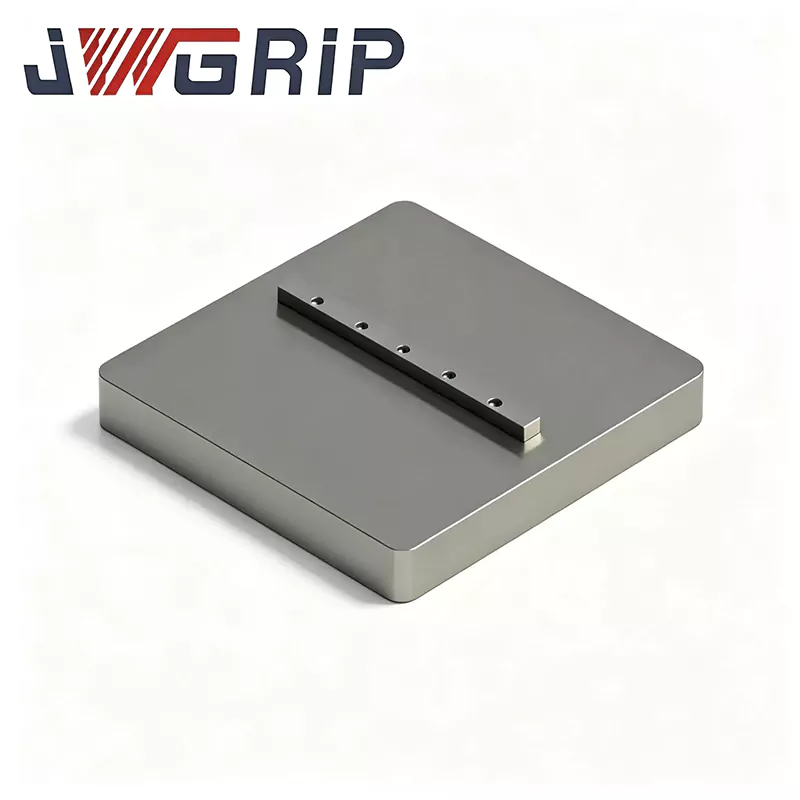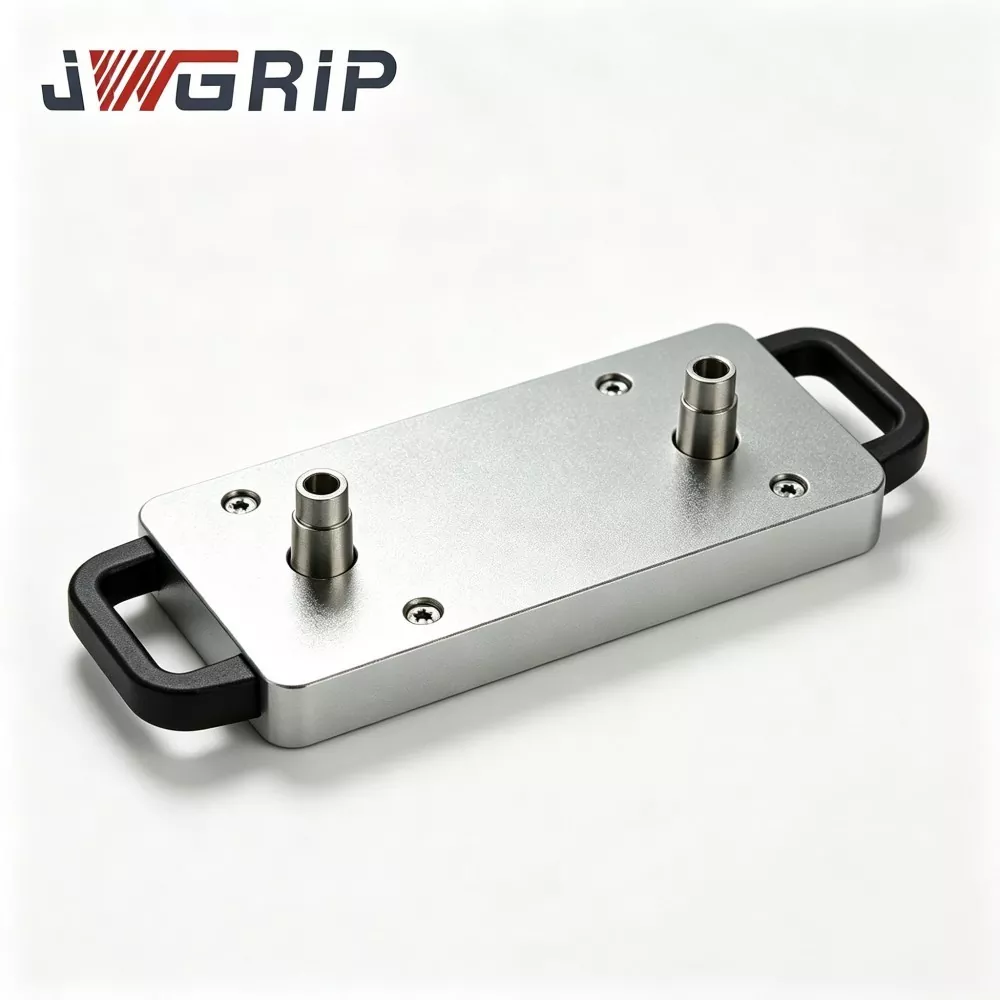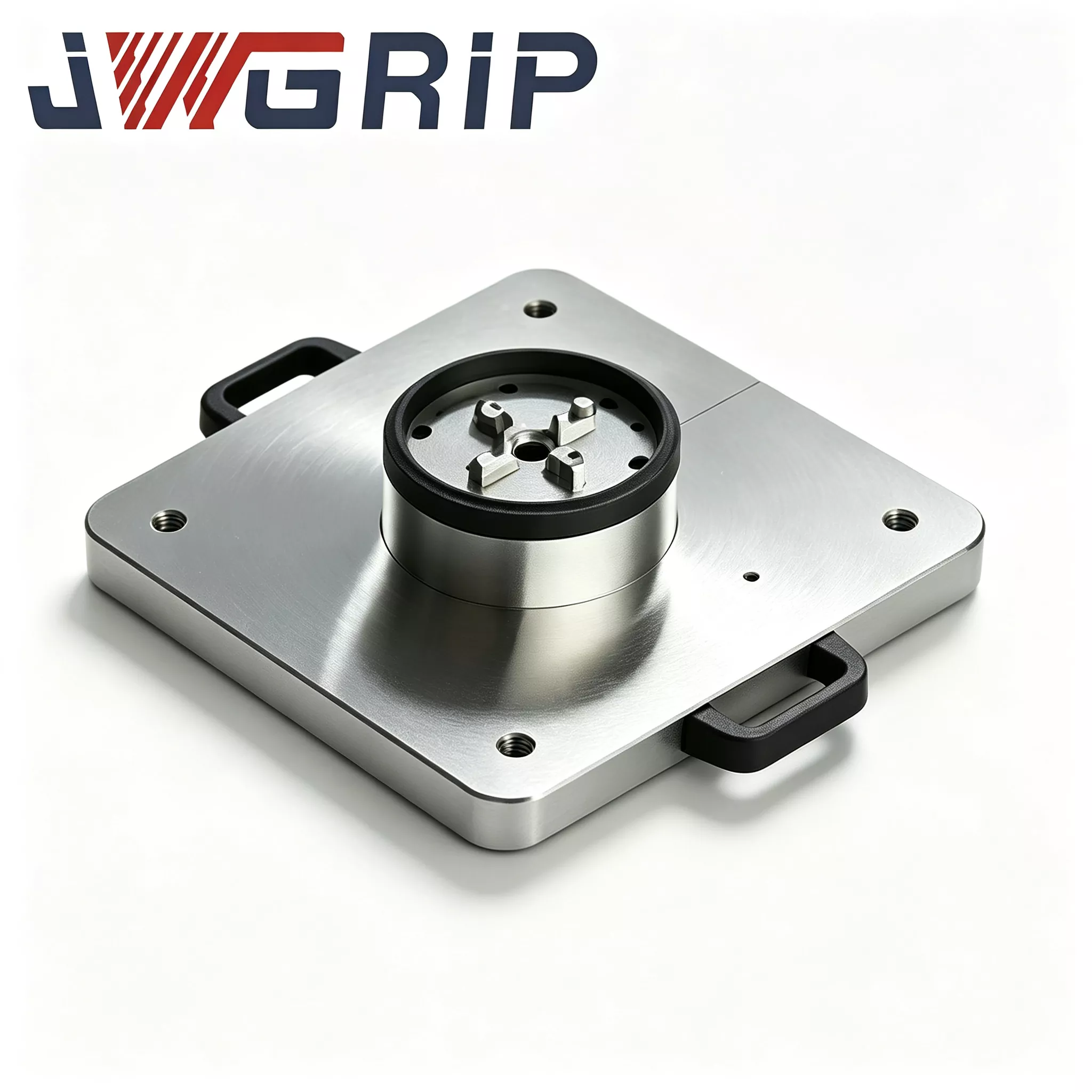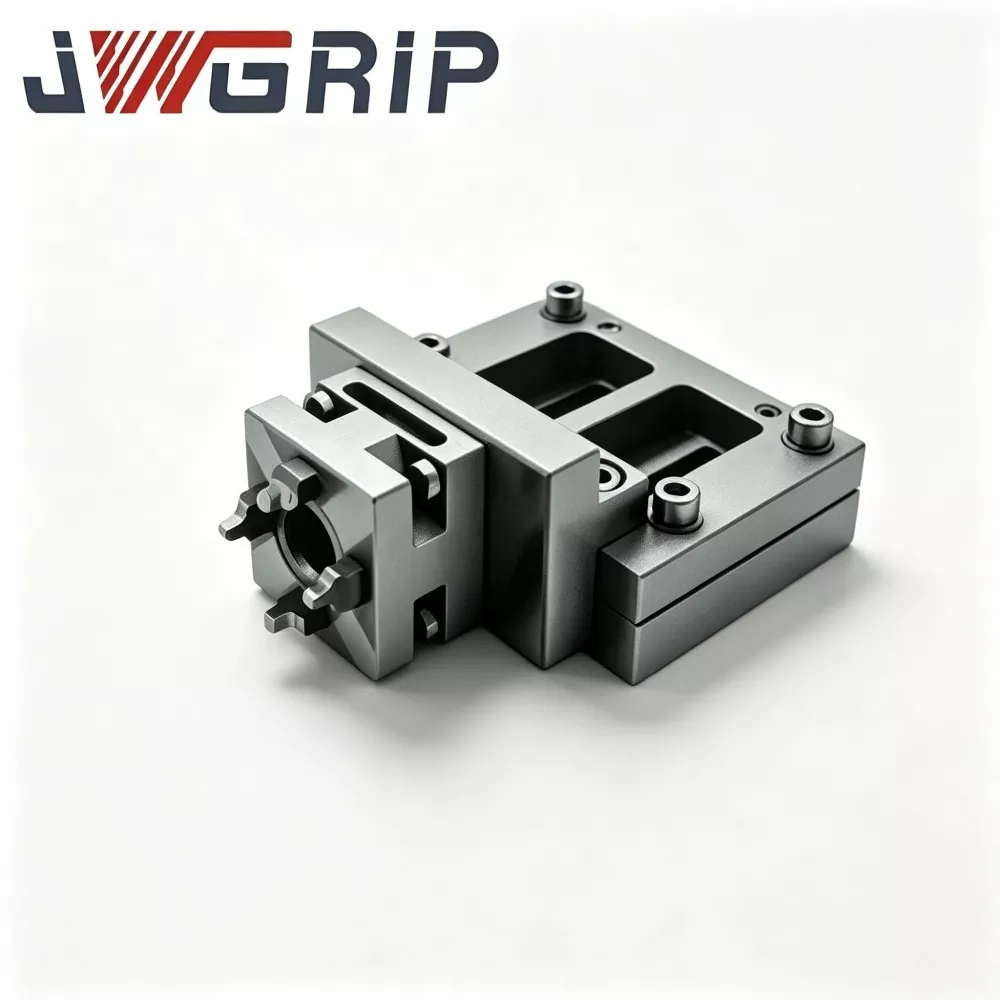
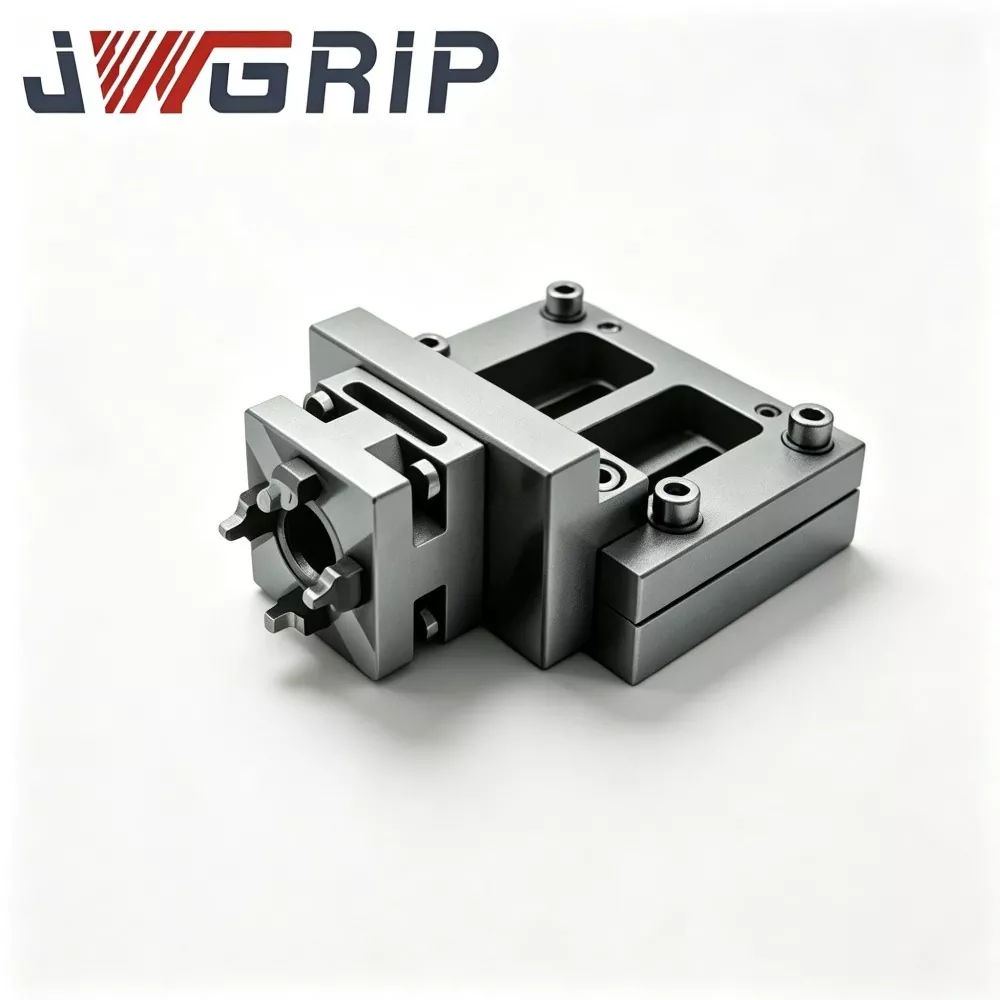
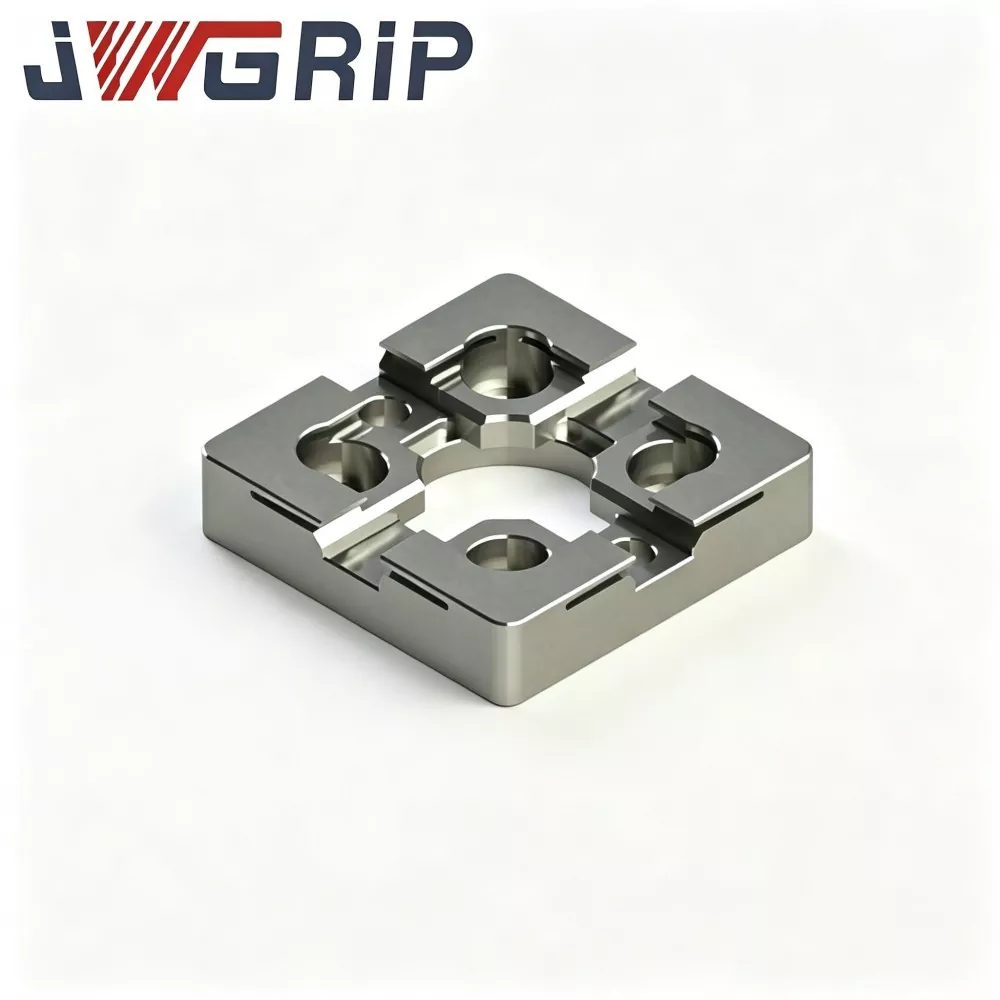
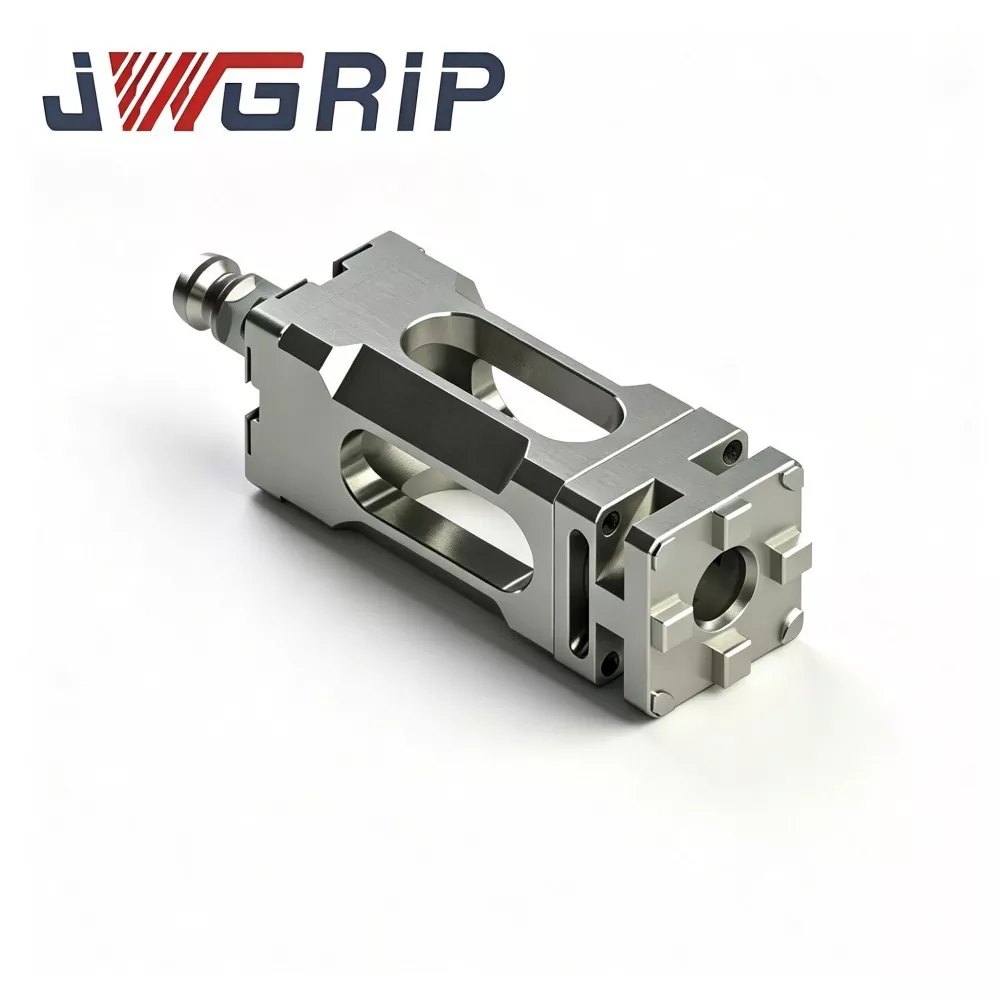
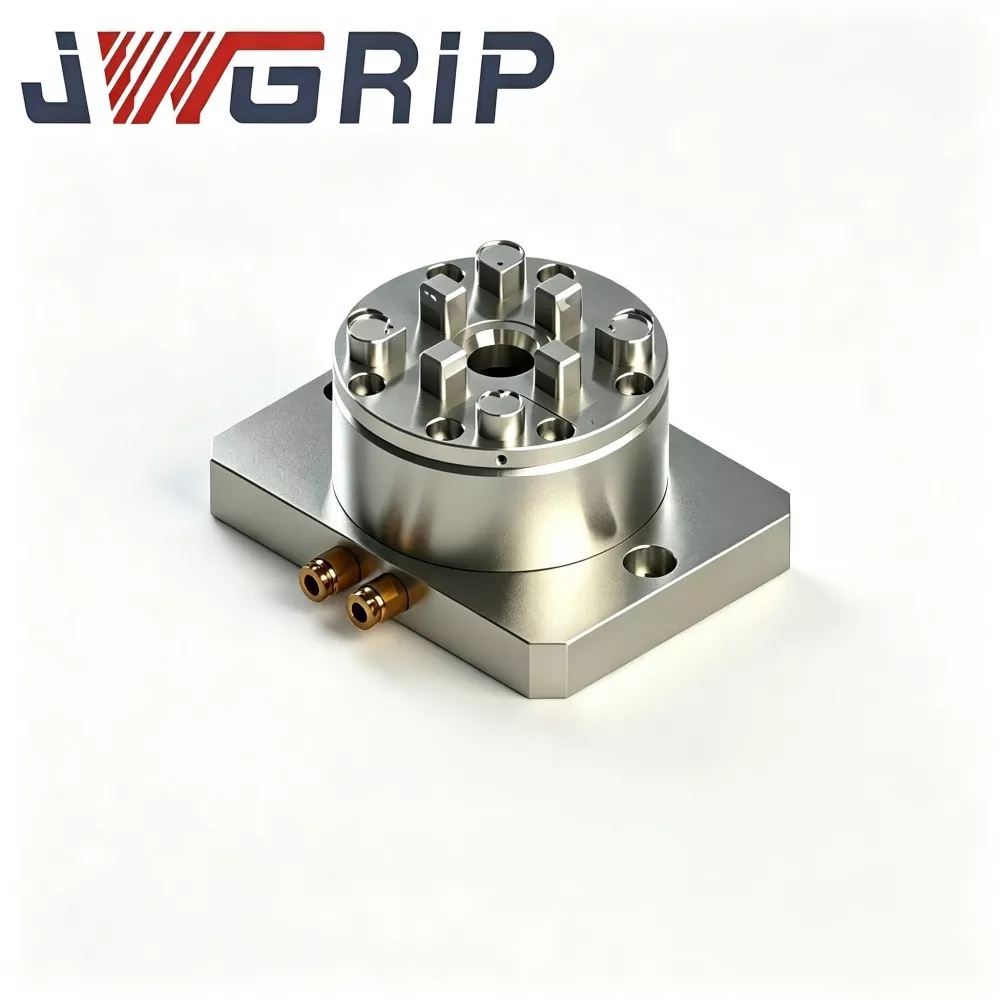
Four-Center Zero Point Pallet for CNC Fixture
JWGRIP is the manufacturer and supplier of the Professional Four-Center Zero Point Pallet for CNC Fixture in China. Four Center Zero Point Pallet belongs to Zero Point Pallet Series, is developed for the widespread high-mix-low-volume mixed-mode production scenarios prevailing in modern machining industry. Welcome to inquire!
This Four-Center Zero Point Pallet for CNC Fixture can effectively solve the problems of flexible production. The four complete zero-point positioning units are integrated into a compact overall base, and the four workstations are completely independent. Users can simultaneously clamp four identical workpieces, or install four different fixtures for mixed-line processing. There is no need for on-site multi-tray assembly. The positions and heights of all workstations have been calibrated before leaving the factory to ensure consistency.
Core Hardware Composition
JWGRIP Four-Center Zero-Point Pallet 120×120 includes the following assemblies:
· Monolithic forged-and-tempered alloy-steel pallet base
· Four independent zero-point bushing locking assemblies in matrix layout
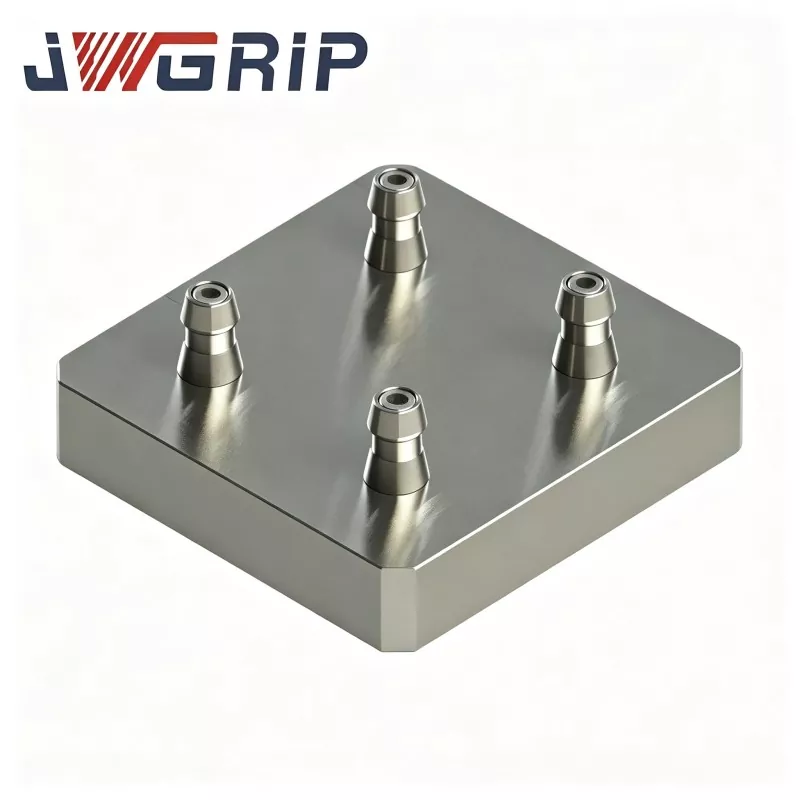
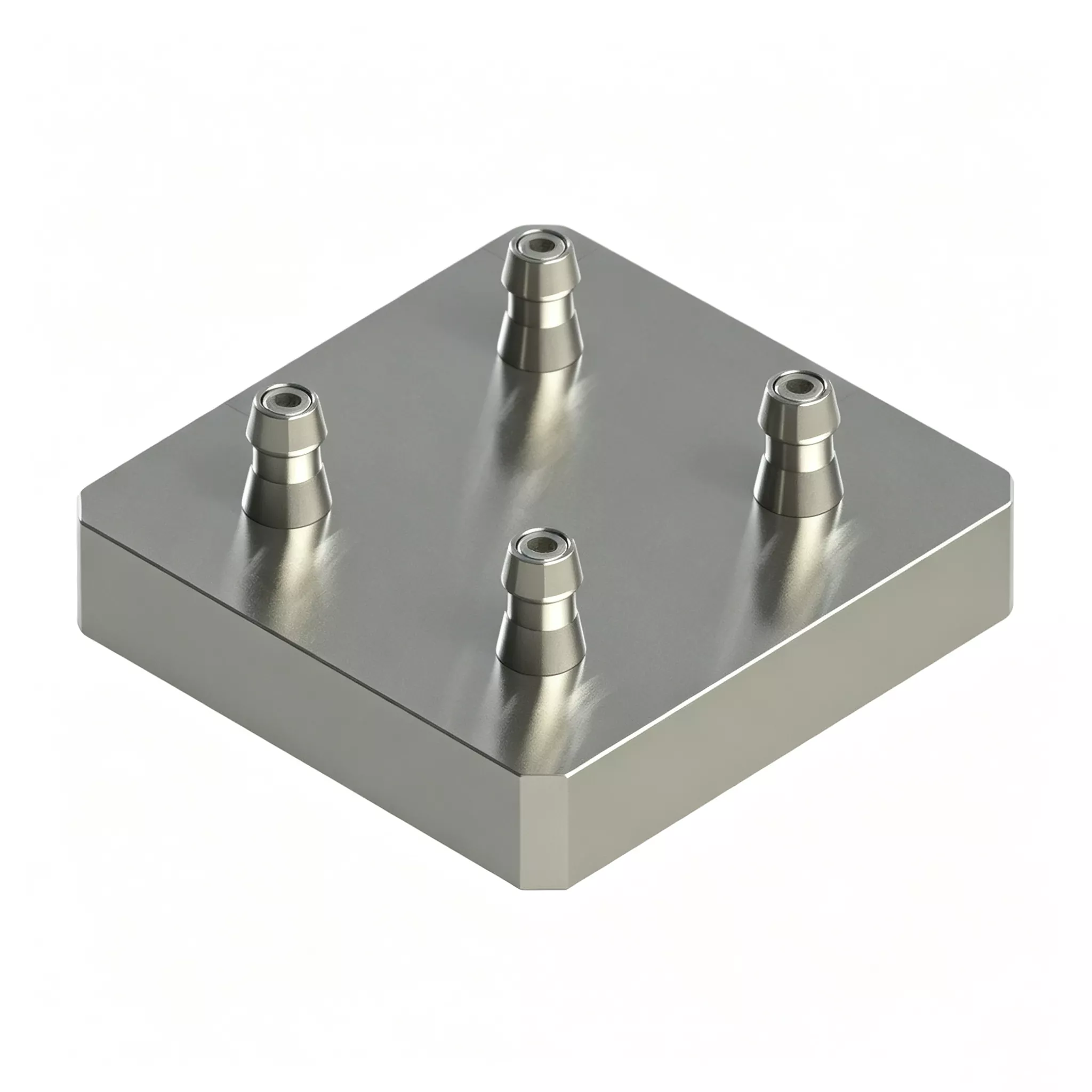
· Built-in synchronous pneumatic distribution module
· Individual chip-diversion grooves for every locating station
· Compressed-air service port
· Protective cover plates to cover idle stations
Its key differentiator versus ordinary multi-station fixtures: four stations operate fully independent of one another.
Two Practical Production Modes
Mode 1: Four-Station Mass-Production for Identical Workpieces
1. Fit four pull-stud-equipped fixture bases onto all four stations.
2. Supply 0.5-0.7 MPa compressed air; the synchronous pneumatic module locks all four bushing assemblies at the same time.
3. Lock-confirmation signal feeds back to CNC system, and the machine executes cutting cycles.
4. Upon machining completion, release air pressure for unlocking. Four finished parts are removed in one cycle to raise hourly throughput.
Mode 2: Flexible Mixed-Line Machining for Different Parts
1. Load fixtures corresponding to four distinct workpieces onto separate stations.
2. Apply compressed air to lock all stations. CNC runs dedicated machining programs sequentially for each station.
3. When one-order production finishes, only replace the fixture on the relevant target station. Remaining stations stay clamped without full teardown.
4. Greatly cuts downtime during frequent product change-overs.
Engineering Design
· The alloy-steel base undergoes two-round stress-relief aging: first aging after rough-machining, secondary aging after semi-finishing. Repeated clamping stress, ambient temperature swings and continuous cutting vibration are common in mixed-mode workshops. Inadequate stress release causes invisible micro-deformation and ruins multi-station positional accuracy. JWGRIP dual-aging maximizes internal-stress release for long-term stable geometry.
· Positioning bushings adopt high-wear-resistant bearing steel. Inner bores receive quenching plus honing super-finishing to guarantee reliable independent locating performance for each station.
· Positional tolerance and station-to-station height difference are strictly controlled to satisfy mixed-line production stability requirements.
Core Advantages
1. Minimize downtime caused by frequent order change-overs
There is no need to disassemble every fixture during product switching. Only stations requiring new-order fixtures get swapped; other stations keep running. Machine idle time drops sharply for high-mix-low-volume order environments.
2. Eliminate human-induced assembly errors from multiple discrete pallets
Manual stacking and mounting of separate zero-point pallets can create positional deviation of 7-8 μm. JWGRIP completes full multi-station calibration in-house: positional tolerance ≤±0.004 mm, station-to-station height difference ≤0.0025 mm. It saves hours of on-site fitting and tuning labor.
3. One hardware covers both mass-volume and high-mix-low-volume tasks
Run four-up identical-part machining for maximum throughput during large-batch orders. Switch to mixed-line mode for fragmented orders. No need to purchase separate fixtures for two production scenarios, lowering fixed-asset investment.
4. Maximize existing fixture asset reuse with standard D20 zero-point pull-stud compatibility
Workshop-existing small-size zero-point fixture bases can be reused directly after retrofitting standard D20 pull studs. Avoid full fixture remanufacturing and preserve previous fixture investment.
5. Per-station independent chip-diversion groove design
Iron and aluminum cutting chips flow away through dedicated grooves for each station. Chip entrapment inside positioning-bushing gaps is greatly reduced. Under frequent fixture-swap mixed-line conditions, cleaning frequency goes down and chip-triggered positioning-failure risk is mitigated.
Real Cases
Case 1: Medical-Device-Accessory Processor
This customer receives typical high-mix-low-volume orders, switching between 3-5 miniature-part variants every working day.
· Before upgrade: single-station zero-point pallets were used. Each change-over required fixture removal, cleaning, re-clamping and dial-indicating, consuming 40-60 minutes. Large amounts of machine hours were wasted on setup work.
· After deploying multiple JWGRIP four-center zero-point pallets and adopting mixed-line machining mode: full fixture teardown is no longer required. Only target-station fixtures get replaced. Average change-over time falls to 8-15 minutes.
· Half-year production statistics reveal machine tool utilization increased by 24%. The factory can accept more fragmented customer orders without buying extra CNC machines.
Case 2: 3C-Component Subcontractor in Pearl River Delta
This workshop handles both high-volume mass orders and small-batch sample jobs on the same CNC machines.
· During mass-order periods: four stations process identical parts for high throughput.
· When small-batch sample tasks arrive: occupy one or two stations for sample production while other stations keep mass-production running.
· Sample processing no longer interrupts mass-production rhythm, and sample delivery lead-time is shortened significantly.
Complete Production Workflow
① Alloy-steel blank forging & tempering
② Rough-machining
③ First stress-relief aging
④ Semi-finishing
⑤ Secondary stress-relief aging
⑥ 5-axis grinder: grind all bushing-mounting holes under one-time clamping setup
⑦ Bushing press-fitting
⑧ Air-circuit seal assembly
⑨ Air-tightness pressure-holding test
⑩ Full-station CMM dimensional inspection
⑪ Anti-rust protection treatment
⑫ Export-ready shock-proof packing
Inspection Checklist
1. Independent repeat-positioning-accuracy test for every single station
2. CMM measurement for four-station positional tolerance, height-difference and parallelism
3. 5-minute air-holding air-tightness test; maximum allowable pressure drop ≤0.02 MPa
4. Cyclic synchronous locking-unlocking functional test across four stations
Selection Guide
· Analyze your order structure: For dominant single-variant mass-production, run four-station identical-part machining. If high-mix-low-volume orders account for a large share, carefully assess fixture-to-fixture physical-interference risk on four stations to avoid collision.
· Confirm specifications of your on-site zero-point pull studs. Standard version matches D20 pull studs. Custom bushing assemblies can be developed for alternative pull-stud sizes.
· For automated-production-line integration: guarantee stable workshop air-source pressure within 0.5-0.7 MPa and reserve IO signal points for PLC control system.
· Calculate total stacking height of workpiece plus fixture. Simulate tool-motion path to prevent tool-to-pallet collision during cutting. Submit workpiece drawings to JWGRIP technical team for interference assessment if you have uncertainties.
Practial Operation
1. Mount the pallet onto machine-tool worktable, tightening bolts strictly according to torque-value requirements in JWGRIP user manual. Over-torque fastening is forbidden, as base-body deformation will destroy multi-station relative accuracy.
2. Install oil-water filter at compressed-air inlet front-end. Moisture and impurities entering bushings will trigger rusting, abrasion and accuracy degradation.
3. Spray dry-lubricant aerosol inside zero-point bushings after every cumulative 100 working hours. Liquid engine oil is strictly prohibited, since oil attracts metallic chips and leads to bushing-jamming failures.
4. Blow-clean locating holes and chip-diversion grooves of each station with compressed-air after fixture swap or at every shift-change. Never leave metallic chips on locating datum surfaces.
5. Fit protective-cover plates onto idle stations to block iron chips and cutting fluid from invading bushing assemblies.
6. Avoid heavy-object impact on pallet datum faces. Collision-caused base deformation usually cannot be repaired on-site and permanently ruins multi-station positional performance.
After-Sales Support
1. Warranty: 12-month full-unit warranty covers manufacturing defects excluding human mis-operation. Qualified claims enjoy free repair or spare-part replacement service.
2. Technical resources: Online operation documents and video tutorials are provided. Paid remote technical support is available for bulk-volume order projects.
3. Custom modification service: Outer-dimension adjustment, pull-stud-spec replacement, station-layout rearrangement are supported.
4. Sample evaluation: Evaluation sample can be arranged; buyer undertakes sample freight cost.
FAQ
Q1: Will mixed-line machining of different-part workpieces on four stations interfere with mutual accuracy?
A: Four bushing units are physically fully independent; locking actions do not interfere with each other. Locating accuracy remains stable as long as fixtures avoid physical collision. Regular compressed-air cleaning for each station is still recommended to prevent chips splashing onto other stations’ datum surfaces.
Q2: Is Four-Center Zero Point Pallet for CNC Fixture necessary if small-batch change-overs happen infrequently?
A: Its change-over-efficiency advantage stands out only under frequent variant-switching every week. If production is mostly single-variant mass-oriented, single-station or dual-station zero-point pallets deliver better cost-performance.
Q3: Can my existing legacy fixture bases be reused on this pallet?
A: Fixture bases fitted with standard D20 zero-point pull studs can work directly. Custom-made bushing assemblies are required for other pull-stud specifications.
Q4: Can JWGRIP Four-Center Zero-Point Pallet 120×120 be deployed on 5-axis CNC machines?
A: It is compatible with 5-axis equipment. Calculate total height of workpiece plus fixture to evaluate spindle-tilting collision risk. Workpiece drawings can be submitted for JWGRIP technical assessment at selection phase.
Procurement Reference Note
Many factories consider purchasing large quantities of custom special-purpose fixtures for flexible-line upgrading. This brings high capital expenditure plus the risk of fixtures becoming idle once orders change.
The core value of JWGRIP Four-Center Zero Point Pallet for CNC Fixture lies in supporting both mass-volume production and high-mix mixed-line manufacturing within one single hardware unit. It maximizes reuse of customers’ existing fixture bases, controls production-retrofit costs and relieves change-over-efficiency pain points caused by fragmented orders. It is well-suited for flexible-upgrade projects for medium-and-small-size component-processing manufacturers.
Hot Tags: Four-Center Zero Point Pallet for CNC Fixture, Manufacturer, Supplier, Wholesale
Send Inquiry
Contact Info
-
Address
No. 44, Daning Entrepreneurship Road, Humen Town, Dongguan City, Guangdong Province, China
-
Tel
-
Email
Welcome to send inquiry to JWGRIP. Our professional technical and sales team will provide free fixture selection, customized solution design and accurate quotation.