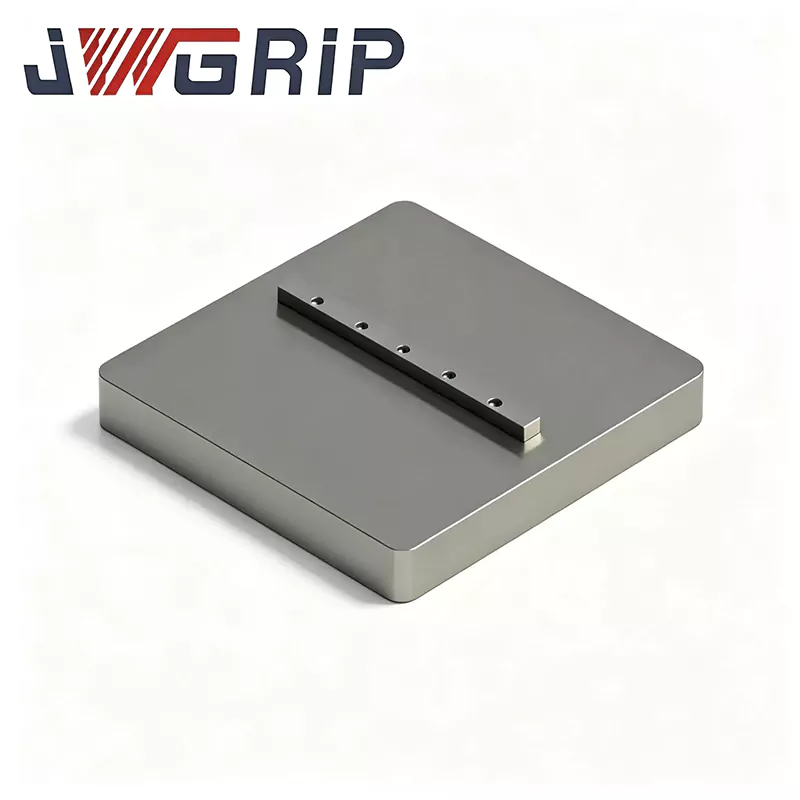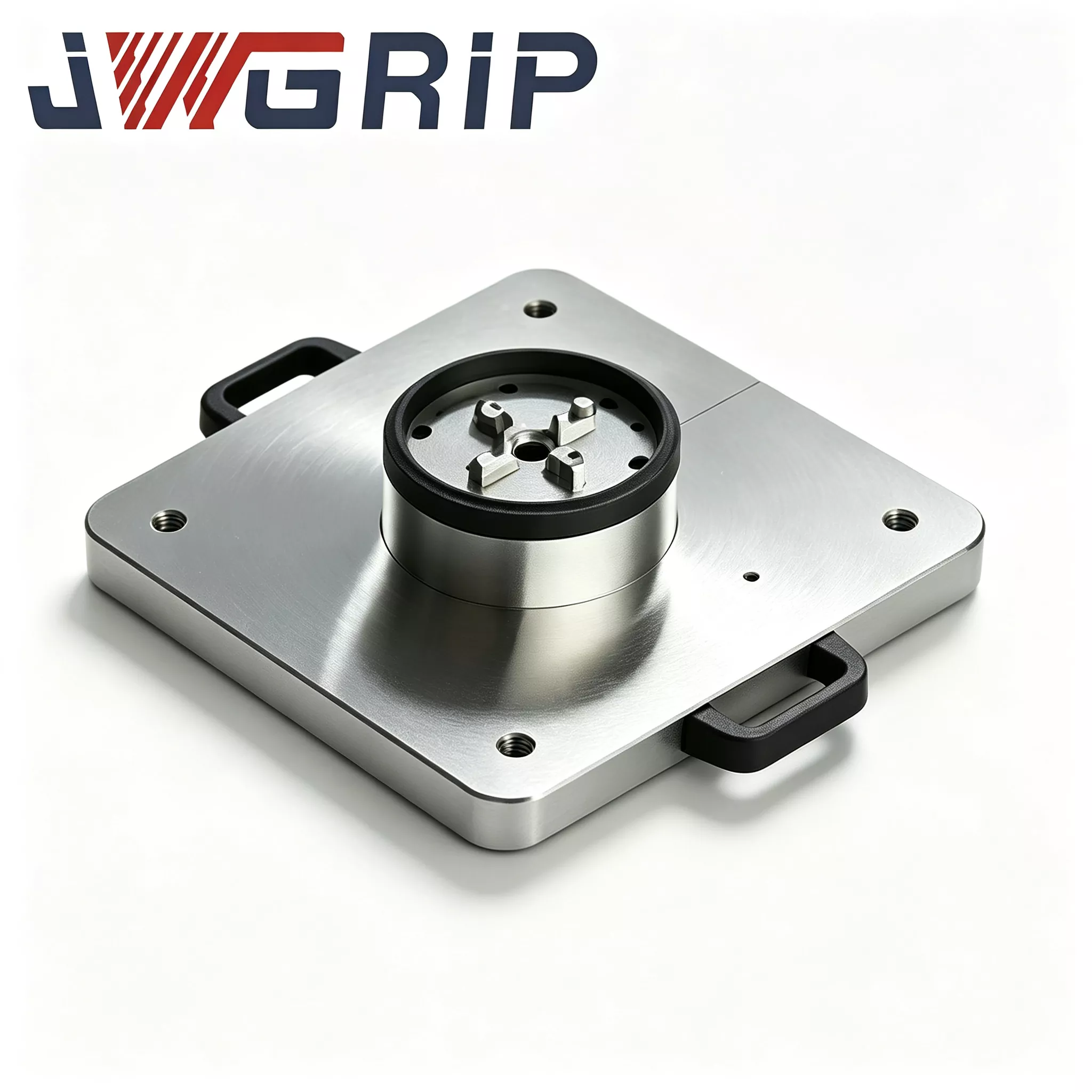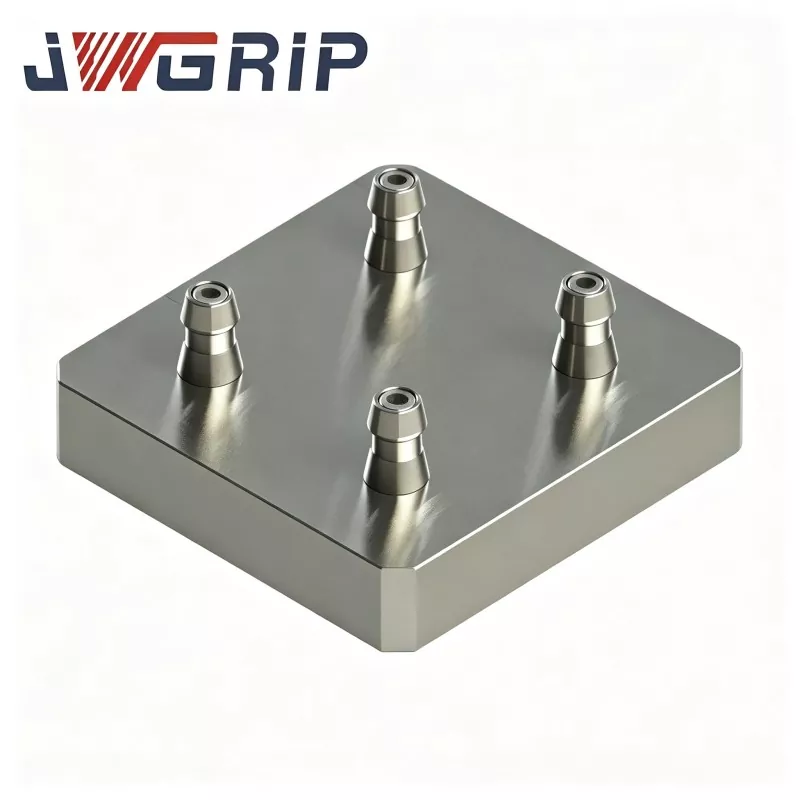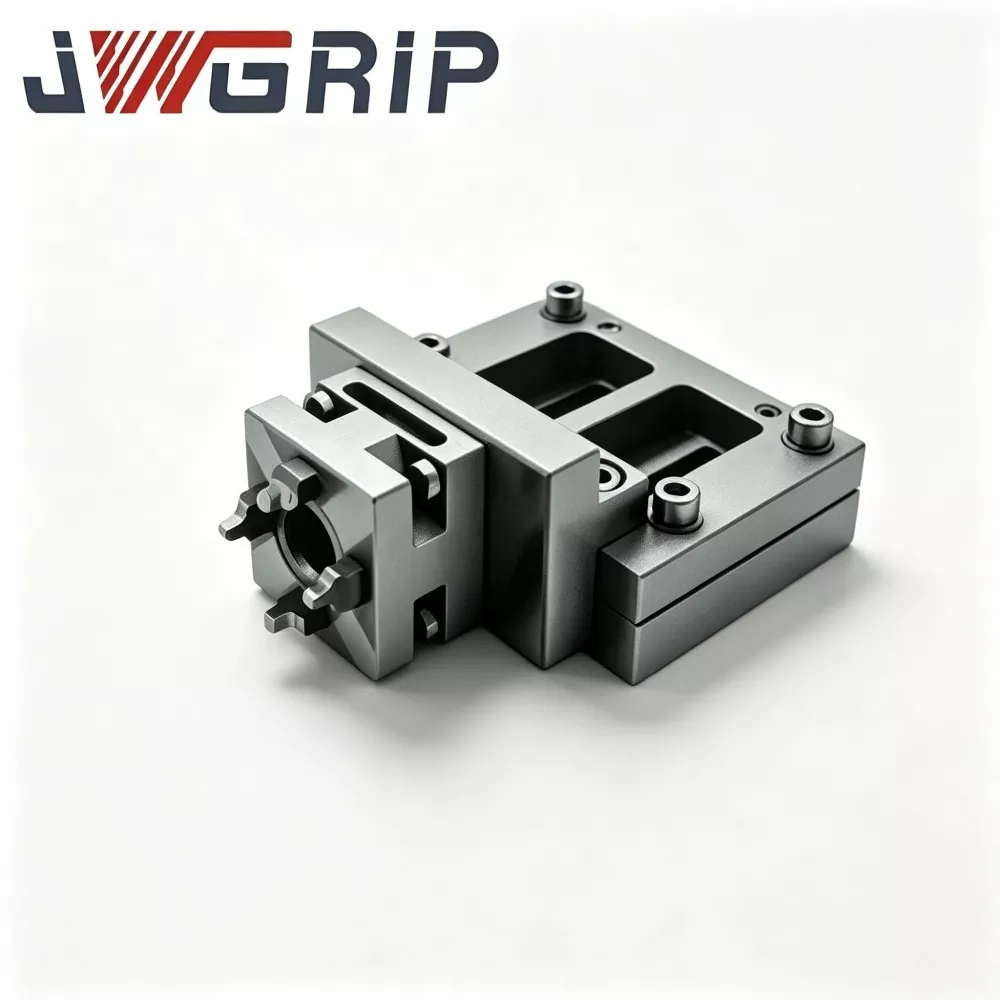
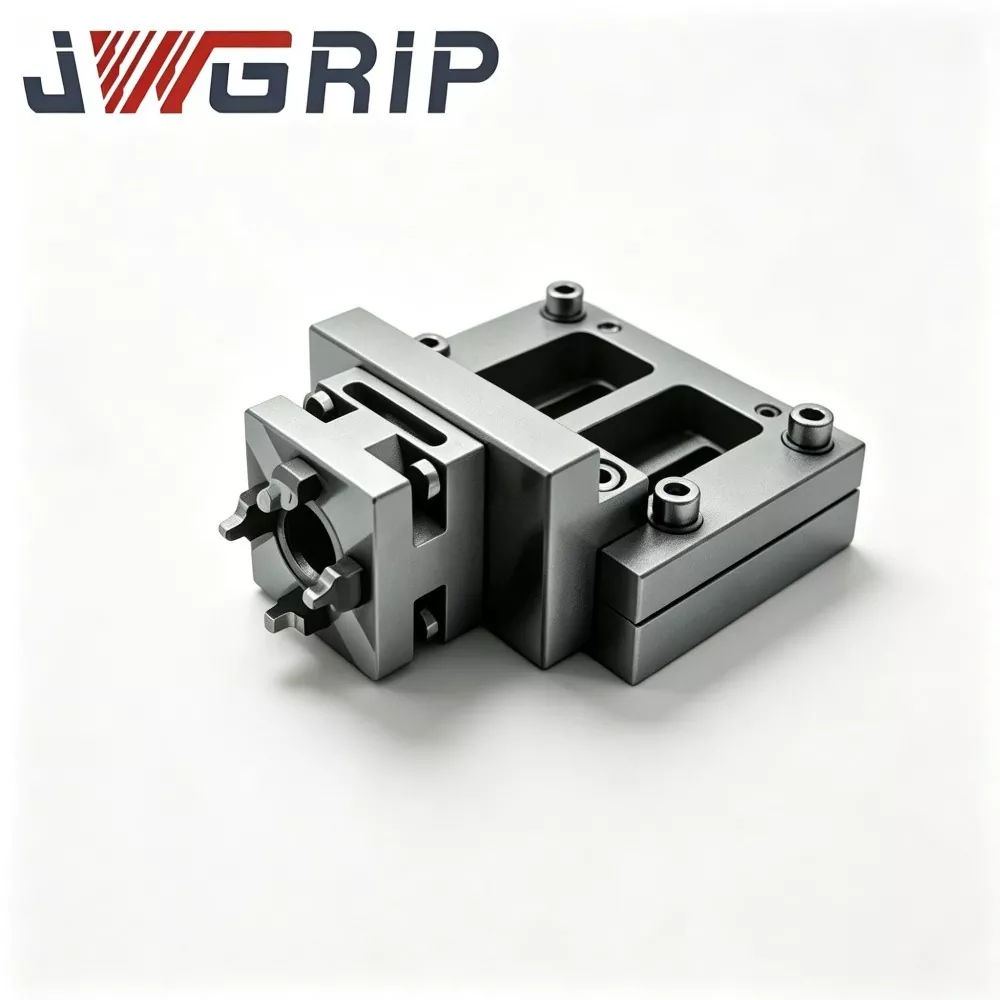
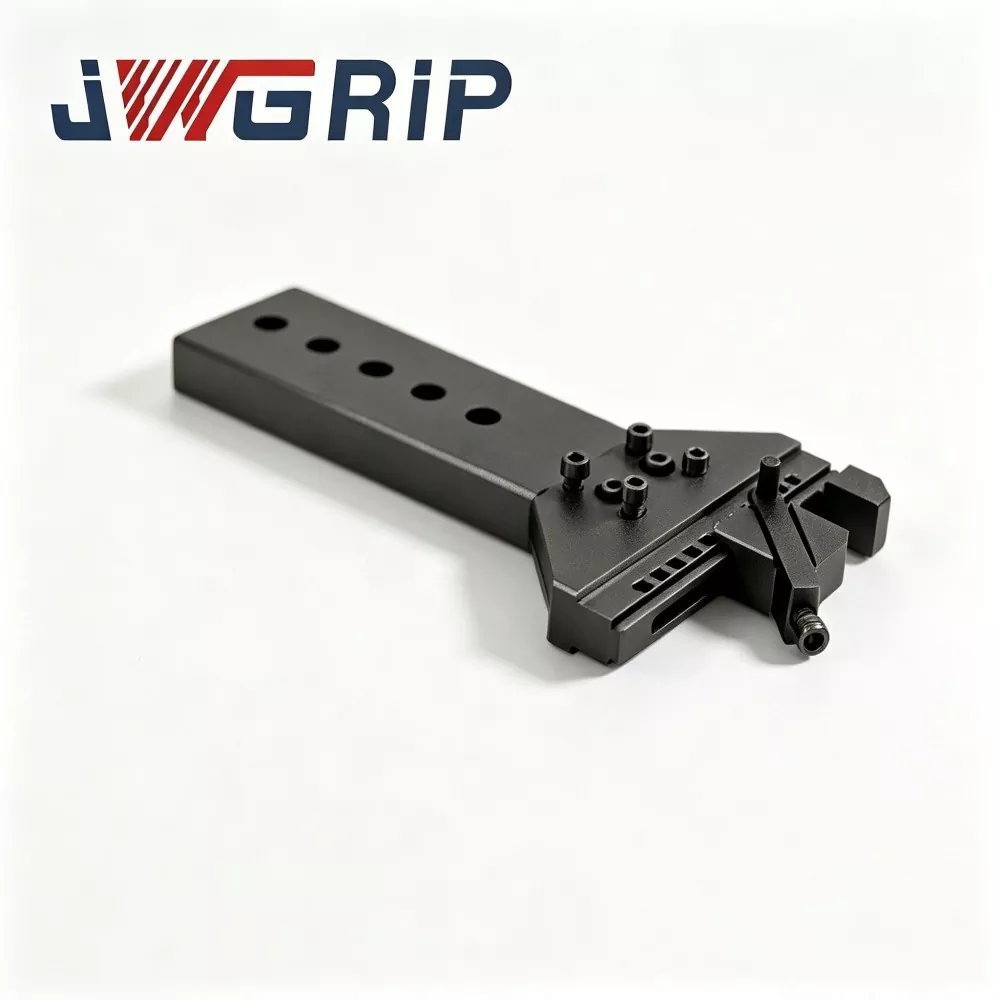
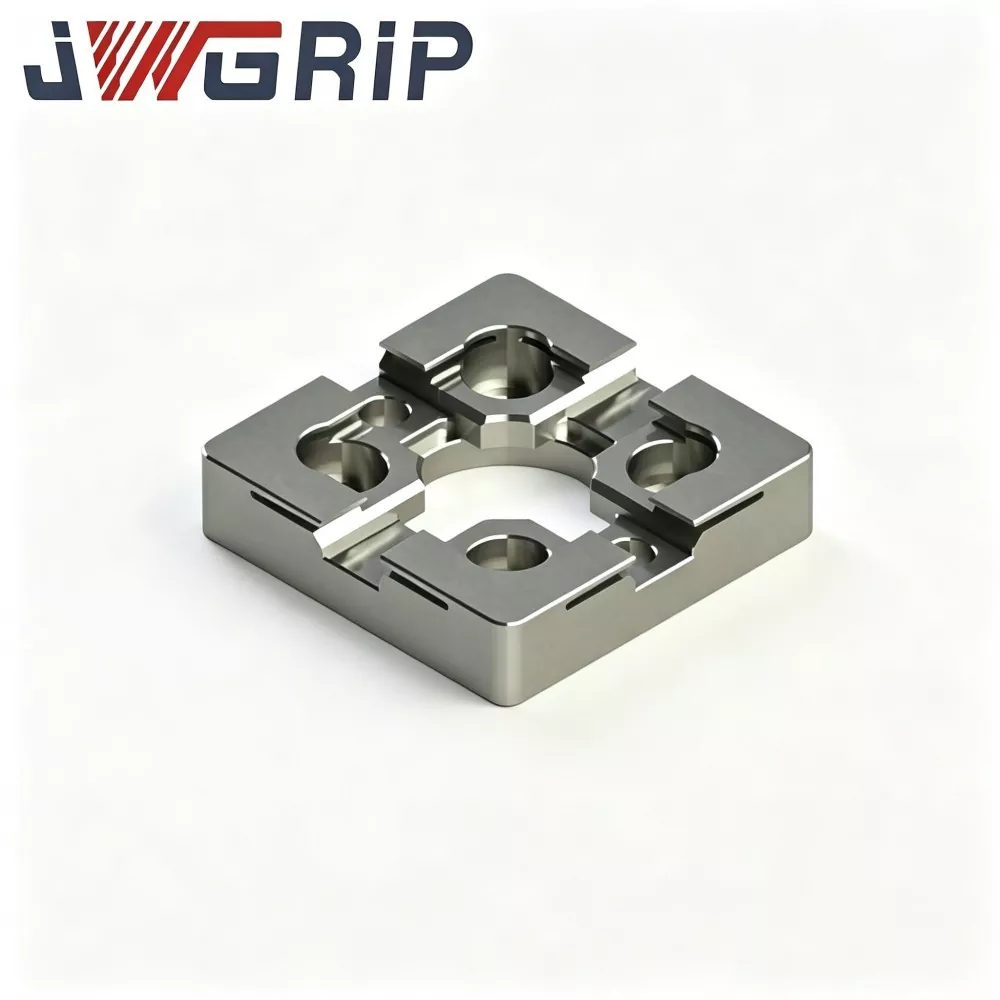
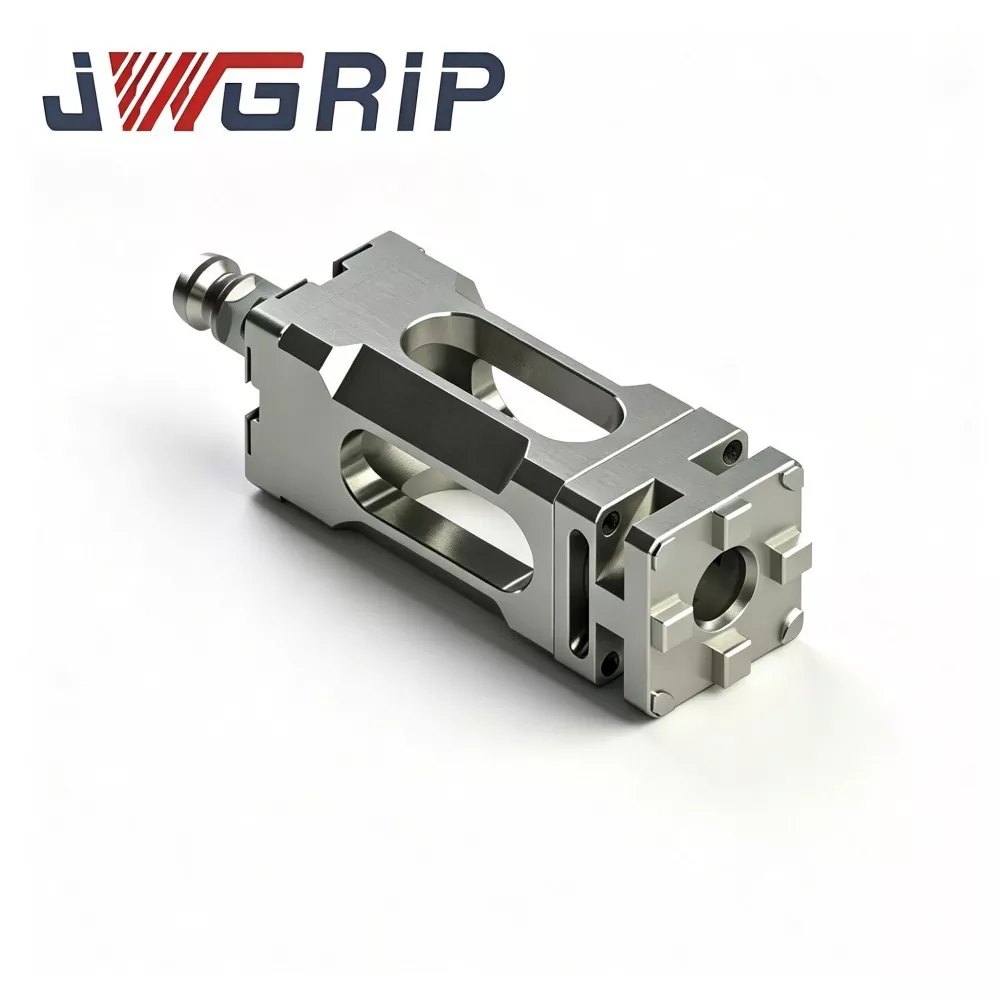
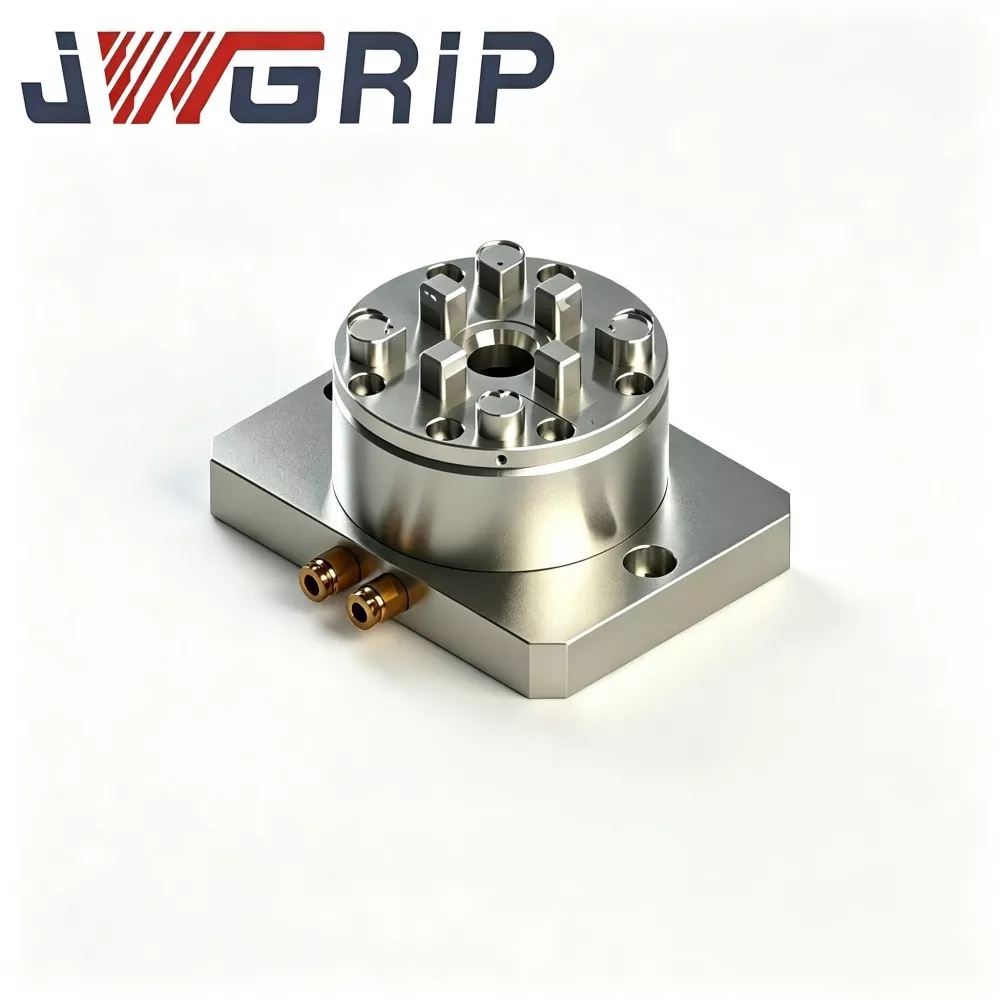
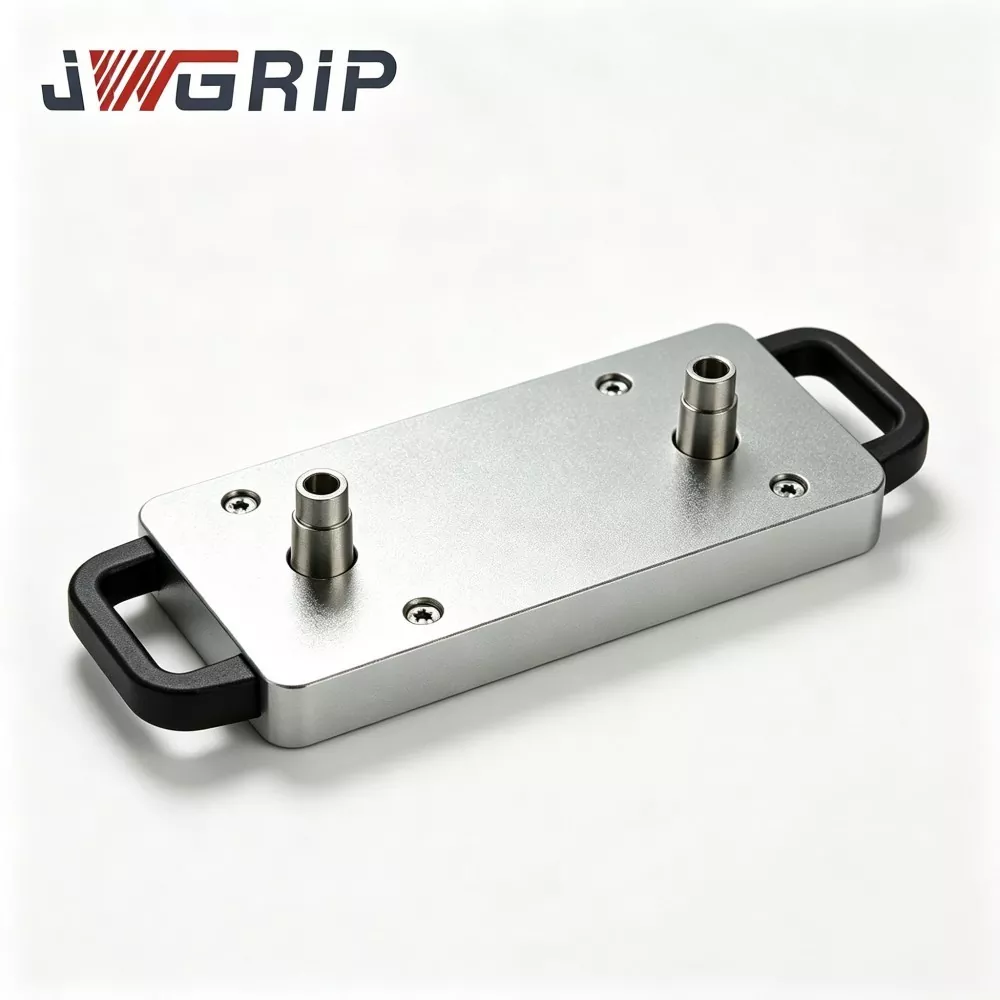
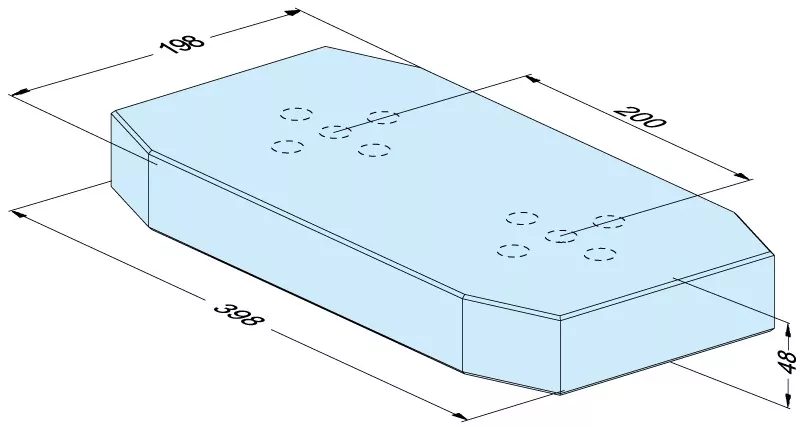
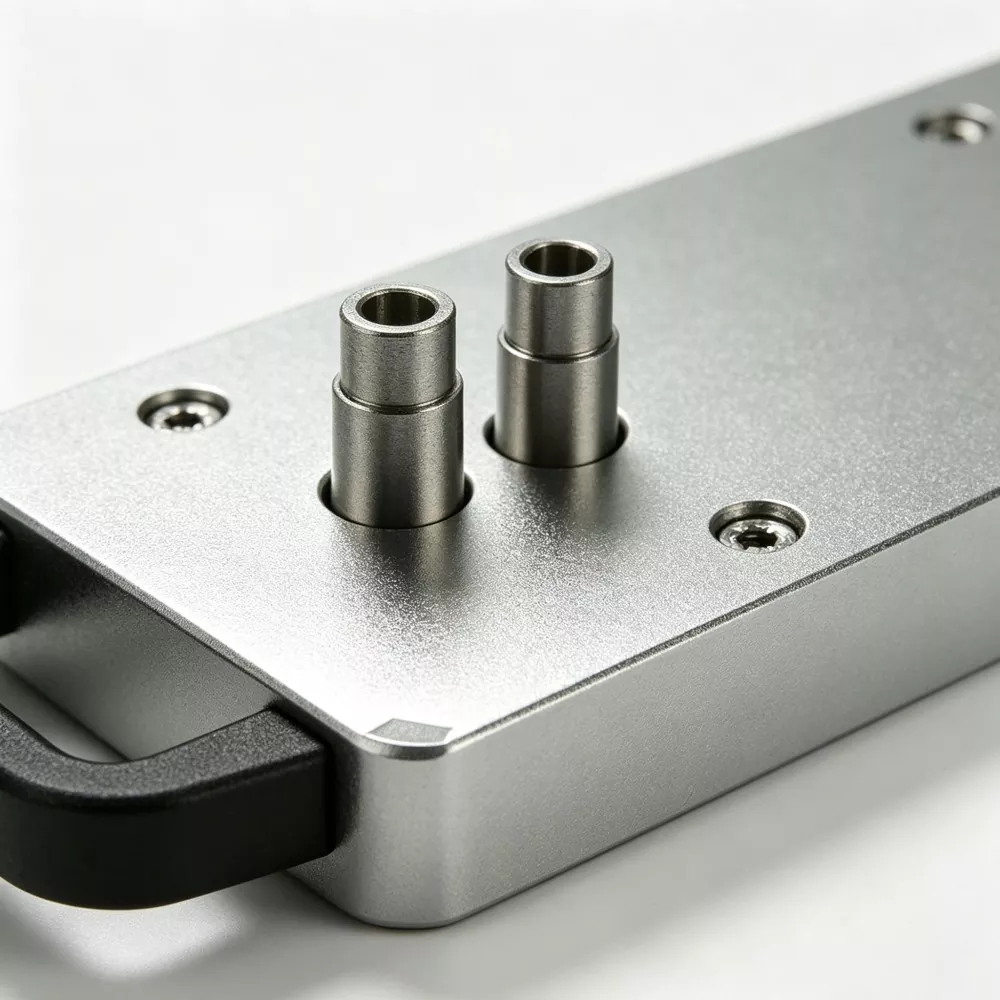
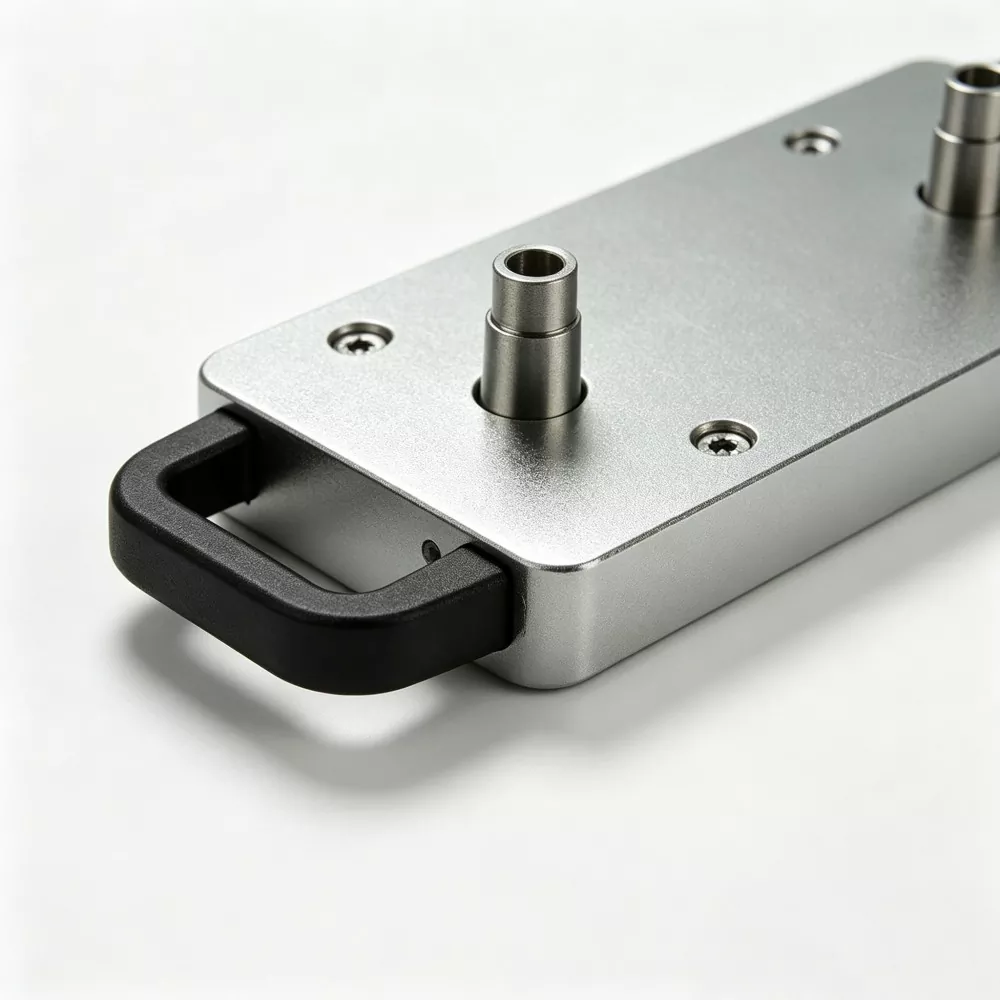
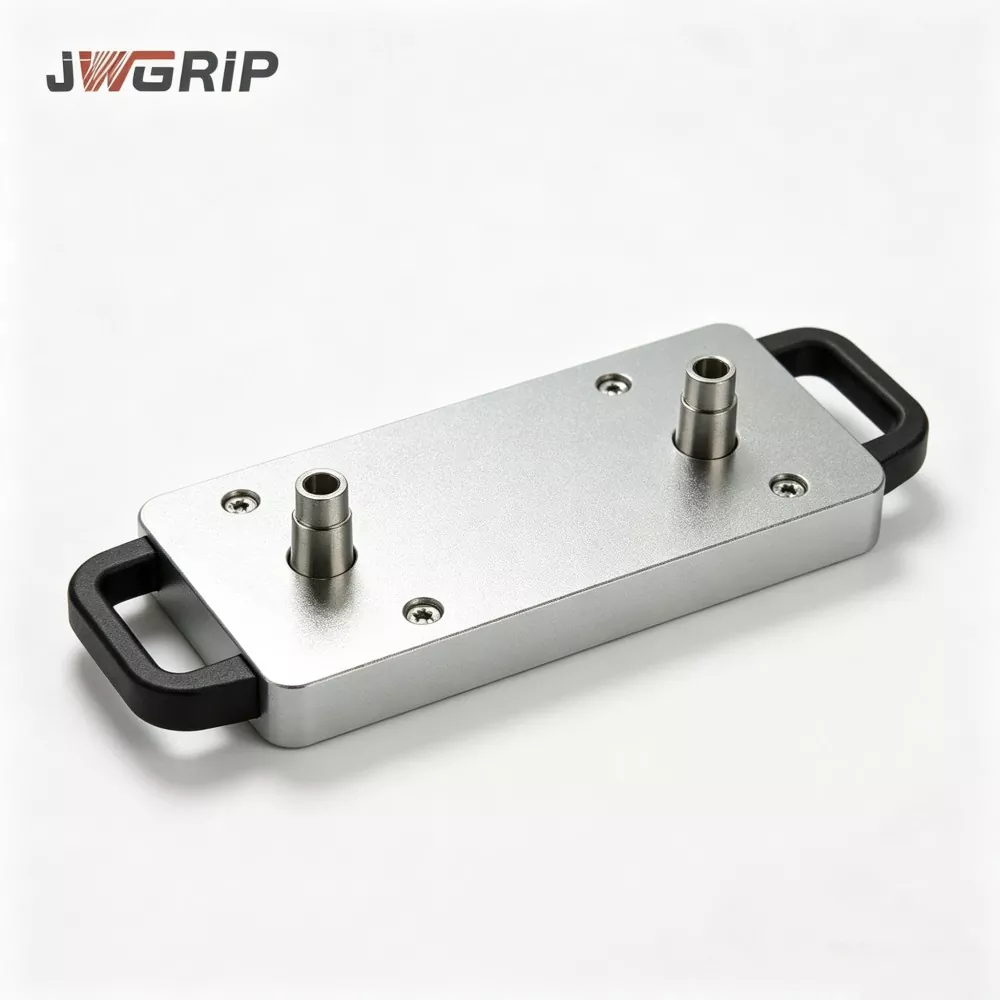
Adopting an integrated monolithic structural design, Two-Center Zero Point Pallet for CNC Machining integrates two complete independent zero-point locating units on a single integral base. The standard 200mm fixed center distance is precisely ground and fully calibrated in-house before delivery, with accurate parallelism, center distance and height consistency between dual stations. It features stable positioning performance, high overall precision and excellent structural rigidity, laying a solid foundation for synchronous dual-workpiece machining.
Main Hardware Components
JWGRIP Two-Center Zero-Point Pallet 200 consists of below key assemblies:
- ① Monolithic alloy-steel base body
- ② Two complete zero-point positioning bushing assemblies with fixed 200 mm center distance
- ③ Synchronous pneumatic locking module
- ④ Surrounding chip-diversion grooves for each locating station
- ⑤ Compressed-air port
- ⑥ Protective cover plates for idle locating station
Two Switchable Production Modes
Dual-Station Paired-Part Machining Mode
1. Manually or via robot, mount two pull-stud-equipped fixture bases onto left-hand and right-hand locating stations respectively.
2. Feed 0.5-0.7 MPa compressed air; the pneumatic module synchronously locks both positioning bushings.
3. Lock-confirmation signal feeds back to the CNC controller, and the machine executes milling, drilling and other cutting processes for two workpieces simultaneously.
4. Once machining finishes, release air pressure to unlock; two finished paired workpieces can be removed in one handling cycle.
Single-Station Independent-Part Machining Mode
1. Install fixture base only on one locating station.
2. Fit the protective cover plate onto the unused station.
3. The pallet acts as a standard single-center zero-point pallet for non-symmetric single-part processing.
Core Engineering
Process Advantages
Real Case
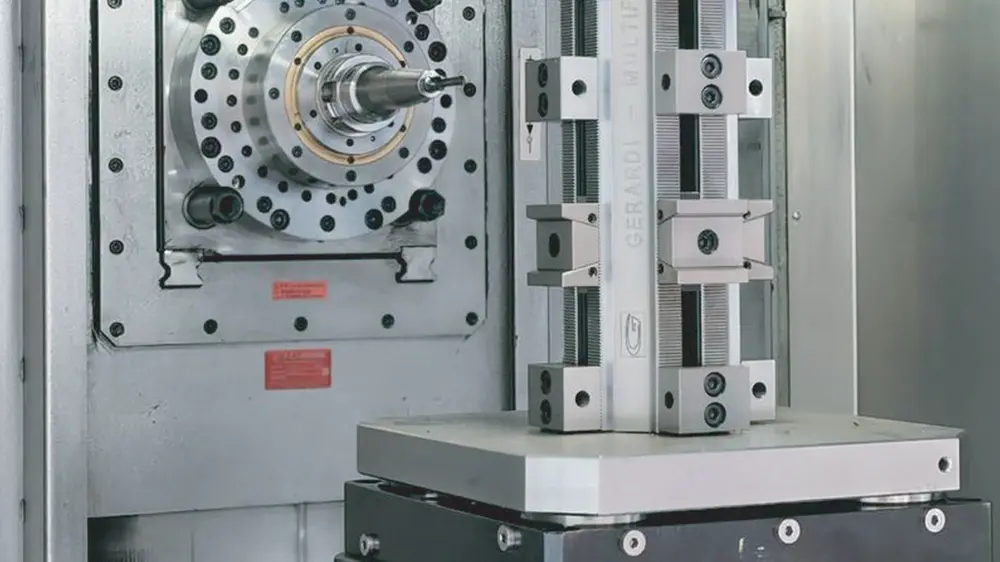
JWGRIP Two-Center Zero Point Pallet for CNC Machining is widely deployed by hydraulic-component plants, new-energy part processors and mold-making manufacturers. Two on-site cases demonstrate tangible operational improvements.
Case 1: Domestic Hydraulic Valve-Block Manufacturer
Before adopting JWGRIP solution, the customer used two independent single-center zero-point pallets for paired valve-block machining.
Every batch change-over needed 20-30 minutes for dual-station alignment.
Cutting vibration brought subtle station shift during mass-production, triggering periodic batch scrap caused by out-of-spec symmetry.
After rolling out eight sets:
- Dual-station relative-position tuning is completely removed. Fixtures can be mounted directly for machining.
- Four-month production statistics show symmetry-caused reject rate dropped by 76%.
- Time previously consumed for calibration converts into effective cutting time, lifting per-machine throughput significantly.
Case 2: East-China New-Energy Automated Production Line
This factory installed JWGRIP two-center zero-point pallets on CNC automatic production lines for left-right symmetric battery housing components.
Robots complete dual-fixture loading-unloading within one cycle and carry out dual-part synchronous machining.
The production line runs stably through night-shift with minimal on-site manpower, free from frequent manual fixture calibration work.
Quality Inspection
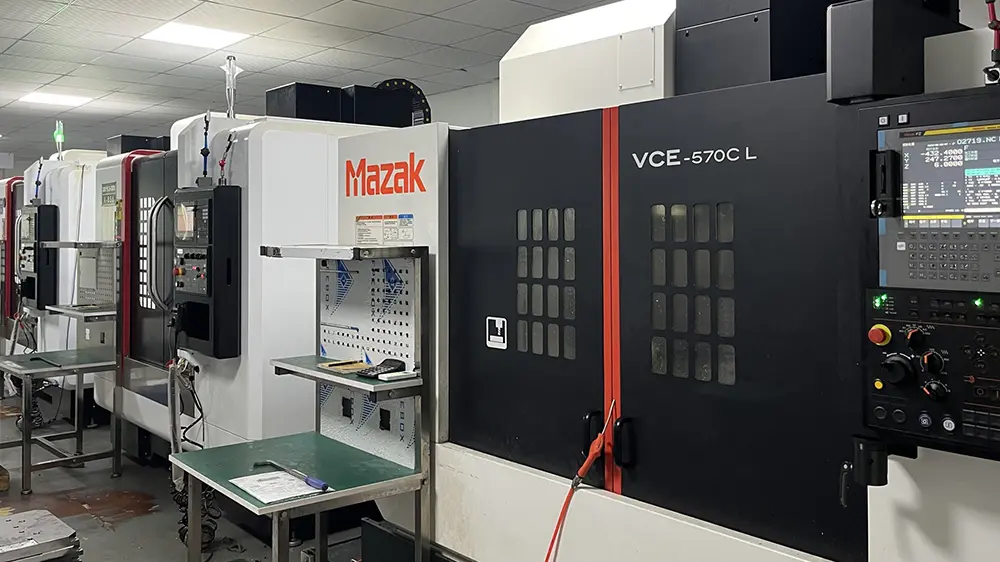
All JWGRIP two-center zero-point pallets are fully machined and assembled in-house without third-party complete-unit OEM outsourcing.
Complete Manufacturing Workflow
- Alloy-steel blank forging & tempering
- Rough-machining
- First stress-relief aging
- Semi-finishing
- Secondary stress-relief aging
- 5-axis grinder: grind two bushing-mounting holes under one-time clamping setup
- Bushing press-fitting
- General assembly
- Air-tightness pressure-holding test
- Full-dimension CMM inspection
- Anti-rust protection treatment
- Export-grade shock-proof packing
Inspection Checklist
✔ Independent repeat-positioning-accuracy test for each locating station
✔ CMM metrology for dual-station center distance, parallelism and height equalizing
✔ 5-minute air-holding tightness test; maximum allowable pressure drop ≤0.02 MPa
✔ Cyclic locking-unlocking functional verification
Product evaluation
1. Confirm your actual production demand for paired-symmetric-part machining. Verify no mechanical interference emerges after installing two fixture bases.
2. Check specifications of your on-site zero-point pull studs. Standard version matches D20 pull studs. Custom bushing assemblies can be developed for alternative pull-stud sizes upon request.
3. For robot-automation-line integration: ensure stable workshop air-source pressure stays within 0.5-0.7 MPa and reserve IO signal points for PLC control system.
4. Calculate total stacking height of workpiece plus fixture, assess collision risk during tool swing or spindle tilting. Submit workpiece drawings to JWGRIP technical team for interference assessment if you have concerns.
Operation Guidance
Secure the pallet onto machine-tool worktable, tightening bolts strictly following torque-value requirements stated in JWGRIP user manual. Violent over-torque fastening is prohibited. Excessive bolt torque will trigger base micro-deformation and damage dual-station geometric accuracy.
Fit oil-water filter at the front-end of air inlet. Moisture and impurities entering positioning bushings will cause rusting and abrasion and result in accuracy drift.
Spray dry-lubricant aerosol inside zero-point bushings after every cumulative 100 working hours. Liquid engine oil is forbidden, as liquid oil attracts metallic chips and causes bushing-jamming failures.
At each shift-change, blow positioning bushings and surrounding chip-diversion grooves thoroughly with compressed air. Never leave metallic chips sitting on locating datum surfaces.
Avoid heavy-object impact onto pallet datum faces. Collision-induced base deformation normally cannot be repaired on-site and will permanently ruin dual-station relative accuracy.
Do not run under overload condition exceeding maximum allowable fixture weight.
Packaging & Shipment
Packaging: Export-grade shock-proof solid-wood cases with thick foam inner buffer. Precision datum surfaces get well-protected against vibration and collision risk during long-distance ocean-shipping transit.
Standard lead-time: 14-20 working days. Partial standard SKUs are kept in stock to support expedited shipment.
After-Sales Support
Warranty: 12-month full-unit warranty covers manufacturing defects excluding human mis-operation. Qualified claims enjoy free repair or spare-part replacement service.
Remote resources: Online installation-commissioning documentation is provided. Paid remote technical support is available for bulk-volume order projects.
Custom modification: Support center-distance adjustment, pull-stud-spec alteration and pneumatic-circuit layout rearrangement.
Sample evaluation: Evaluation sample can be arranged; buyer shall bear sample freight cost.
Frequently Asked Questions
Q1: Can JWGRIP Two-Center Zero Point Pallet for CNC Machining perform single-part machining using only one station?
A: Yes. Place protective cover plate over idle station, and it works as regular single-station zero-point pallet. Switching modes supports both single-part and paired-part production scenarios without impairing overall pallet performance.
Q2: Why does dual-station center-distance accuracy drift after a period of operation?
A: Typical root-causes: metallic chips trapped inside positioning gaps; bushing rusting caused by moisture-mixed compressed air; base deformation from heavy-impact collision; micro-deformation from long-time overload loading. Perform thorough cleaning and maintenance first. Collision-triggered base deformation usually cannot be repaired on-site and requires factory-return assessment.
Q3: Can my existing legacy zero-point fixture bases be reused on this pallet?
A: Fixture bases fitted with standard D20 zero-point pull studs can be used directly. Custom-made bushing assemblies are required for other pull-stud specifications.
Q4: Is JWGRIP Two-Center Zero-Point Pallet 200 compatible with 5-axis CNC machine tools?
A: It works with 5-axis machines. Please provide total height of workpiece plus fixture during selection phase; JWGRIP will assess spindle-tilting collision risk for you.
Procurement Decision Insight
Many manufacturers producing symmetric paired workpieces tend to buy two separate single-center pallets for lower upfront procurement expenditure. However, hidden costs keep accumulating from repeated alignment labor hours and symmetry-related workpiece scrap.
JWGRIP Two-Center Zero Point Pallet for CNC Machining integrates two datum references onto one monolithic base. It addresses symmetry risks stemming from discrete-pallet calibration and vibration-induced positional offset. It cuts comprehensive production losses for paired-part manufacturing, suitable for traditional manual workshops as well as factories carrying out automation-line upgrading.
Ready to upgrade your paired-part machining?
Request a quote or evaluation sample for JWGRIP Two-Center Zero Point Pallet.
Contact JWGRIP Now* For custom center-distance, pull-stud specification, or automation integration, please contact our technical team. Standard D20 pull studs compatible.